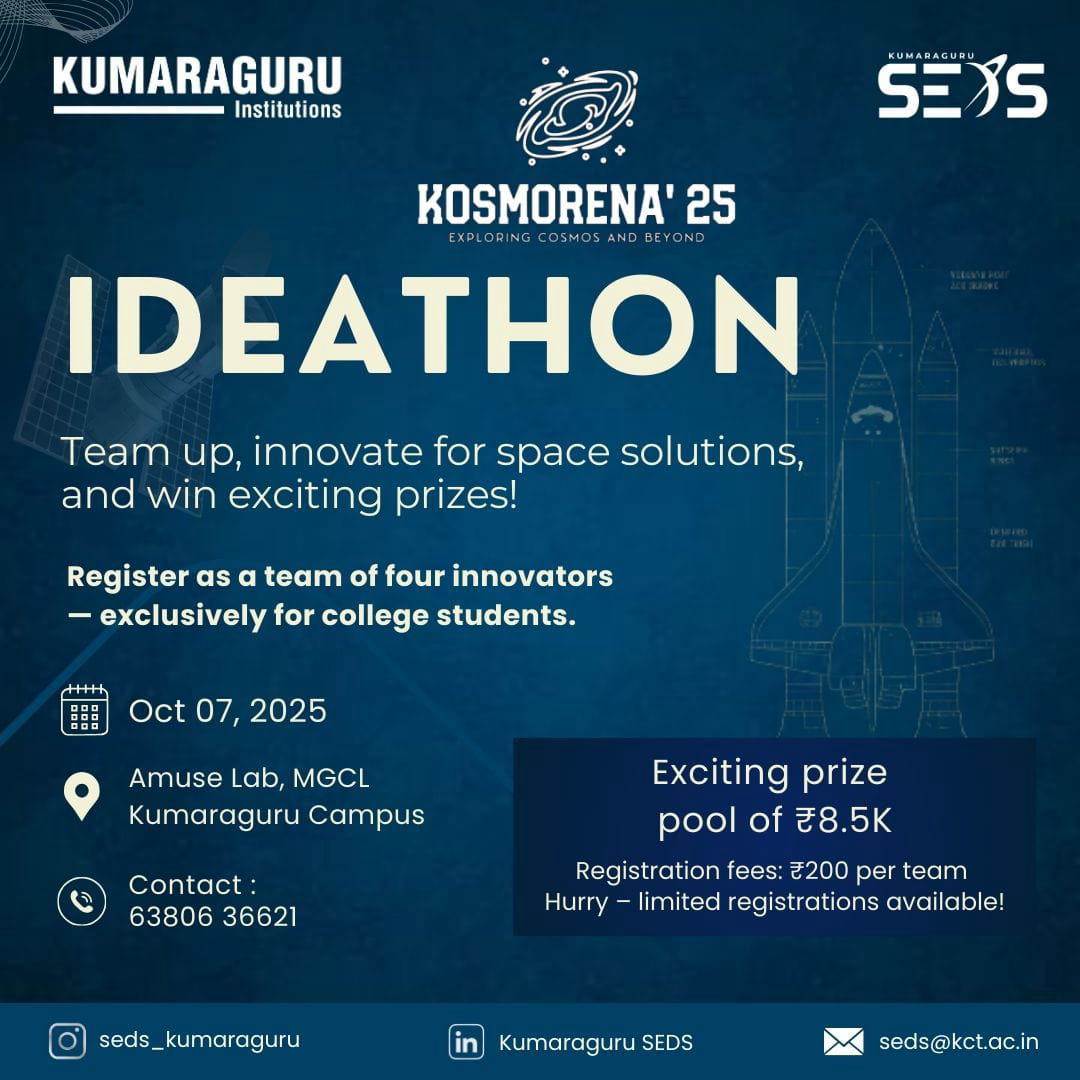
SPACE INNOVATION IDEATHON
Theme: Space • Software • Hardware • Artificial Intelligence
KOSMORENA 2026 Space Innovation Ideathon is a one-day flagship hackathon where students receive official problem statements on event day through a novel quiz-based auction, develop innovative software, hardware, simulation, or AI/ML solutions, and defend them before an expert jury.
ABOUT THE SPACE INNOVATION IDEATHON
KOSMORENA 2026 presents the Space Innovation Ideathon, organised by the SEDS Club at Kumaraguru College of Technology. In this one-day intensive challenge, multidisciplinary student teams receive their official problem statement on event day, analyse the challenge, formulate an innovative and technically justified engineering architecture, and present their defense within a tight operational timeline.
The competition spans applications across Space, Software, Hardware, and Artificial Intelligence, including robotics, agriculture, embedded systems, telemetry data processing, and autonomous systems. SEDS Kumaraguru provides all workspace infrastructure, power supplies, review panels, and evaluation platforms on-site.
QUIZ-BASED PROBLEM STATEMENT AUCTION
Official problem statements are revealed on the event date through a supervised competitive auction. Rather than static assignment, teams actively compete for problem statements based on their technical mastery:
A 30-question technical quiz is conducted individually for every team member within a strict 15-minute window before the auction.
Team Bidding Power is calculated from individual
scores: (Sum of Member Scores / Team Size) × ₹1 Lakh.
Teams deploy their cumulative bidding capital to win their preferred problem statement. The secured problem becomes the official mission.
Note: Prior access to problem statements is strictly prohibited. Clarifications announced by organizers apply equally to all competing teams.
ACCEPTABLE SOLUTION FORMATS & AI USAGE
A complete physical prototype is not mandatory unless specifically mandated by your chosen problem track. Technical reasoning, feasibility, and empirical justification are valued over gratuitous complexity. Teams can demonstrate technical depth via:
- Conceptual engineering solution
- System architecture & workflow
- Software prototype / link
- AI/ML proof of concept & metrics
- Simulation & mathematical models
- CAD/mechanical mechanism design
- Embedded system & sensor circuit
- UI/dashboard interface
- Integrated hardware proof-of-concept
- Testing & validation evidence
AI Usage & Academic Integrity Policy
AI tools may be used responsibly for brainstorming, coding assistance, debugging, and documentation support. However, teams remain 100% accountable for technical correctness and original understanding. Every member must be capable of defending all architectural choices before the jury. Fabricated data, falsified test results, and plagiarism lead to immediate disqualification.
DOMAINS & THEMES
OFFICIAL RULES & PARTICIPANT CHECKLIST
- RULE 01 Team Composition: Teams must have 2 to 4 members. Every member must contribute actively across research, architecture, software, hardware, simulation, or defense presentation.
- RULE 02 Mandatory Student ID: Every delegate must carry a valid College / University Student ID card to present upon check-in and anytime requested by organizers.
- RULE 03 Quiz-Based Auction: Problem statements are secured through the 15-minute 30-question quiz auction mechanic. Teams must develop solutions for their won statement.
- RULE 04 Shift-Based Lunch Protocol: Lunch is scheduled from 12:30 PM to 1:30 PM. At least TWO members must remain at the designated workspace table at all times. Full team must reassemble by 1:30 PM sharp for attendance.
- RULE 05 Technical Q&A Defense: Final deliverables include a solution pitch deck, architecture block diagram, methodology, and demo/PoC, defended live before jury questions.
- RULE 06 Electrical & Lab Safety: Only approved power supplies and hardware connections are allowed. Hazardous chemicals, exposed high-voltage wiring, or open flames are prohibited.
FINAL EVALUATION CRITERIA (100 MARKS)
The technical evaluation jury will score each team against eight core criteria as defined in the official rule book:
| Evaluation Criterion | Maximum Marks |
|---|---|
| Problem Understanding & Gap Analysis | 15 |
| Innovation & Originality of Approach | 15 |
| Technical Depth & Engineering Rigor | 20 |
| Feasibility & Practical Implementation | 15 |
| Validation / Prototype / Empirical Evidence | 10 |
| Impact, Scalability & Mission Scope | 10 |
| Presentation Quality & Communication Clarity | 5 |
| Technical Defense & Q&A Handling | 10 |
| TOTAL EVALUATION SCORE | 100 MARKS |
EVENT SCHEDULE — 14 OCTOBER 2026
Student arrival, ID verification, kit distribution, and team workspace allocation at Amuse Lab.
Welcome address, symposium inauguration, and briefing on challenge scope by aerospace faculty mentors.
Individual 30-question technical quiz (15 min) followed by live problem statement bidding auction.
Intensive design sprint: problem gap analysis, system architecture, simulation, CAD, and prototype building.
Two-member shift-based lunch with continuous workspace presence, followed by mandatory 1:30 PM reassembly.
Formal technical pitch defense and Q&A before the evaluation panel, followed by cash awards ceremony.
PRIZES & CERTIFICATES (₹14,500 TOTAL POOL)
1st Place Winner
Winner Trophy + Certificate of Excellence + Research Mentorship & Lab Access
Runner-Up
Runner-Up Trophy + Certificate of Merit + SEDS Space Innovation Commendation
5 Special Category Prizes
Five special category awards recognizing engineering uniqueness across key disciplines
Five Domain Recognitions
✓ Official Participant Certificate provided for EVERY registered attendee.